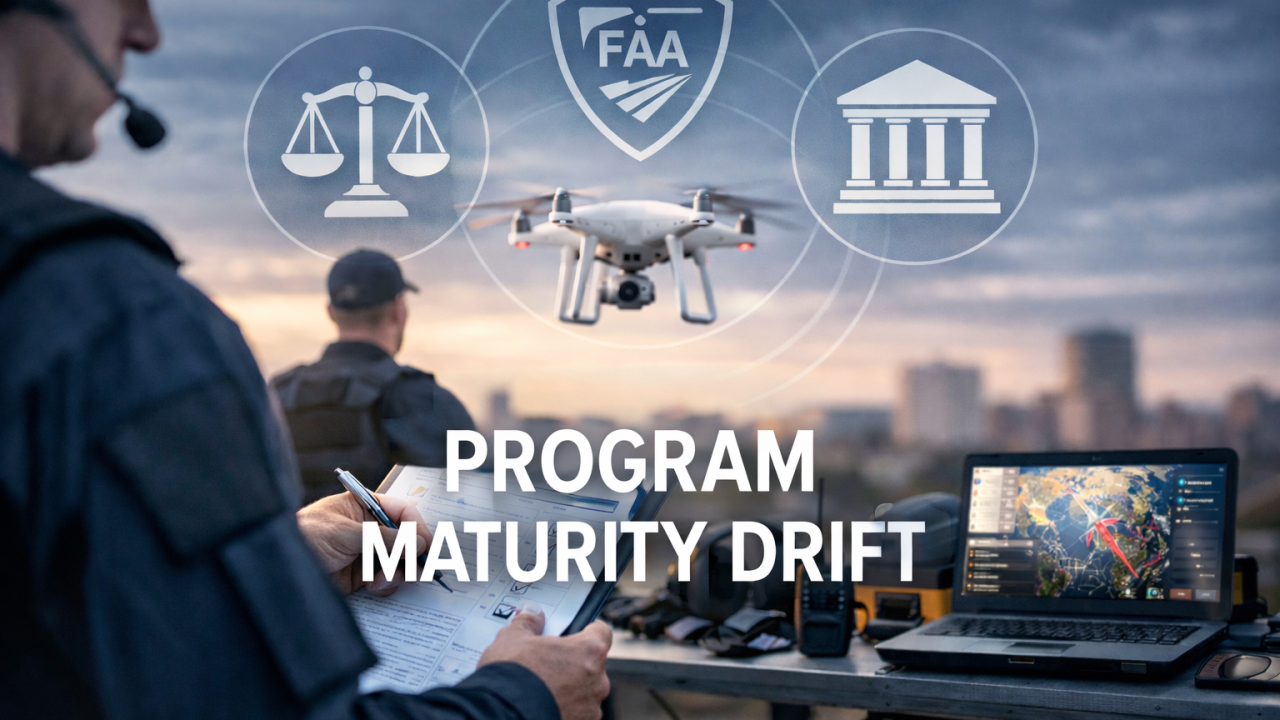
Why many successful drone programs quietly accumulate risk as they grow
Most drone programs do not fail in their early stages. In fact, many begin with immediate success.
An organization acquires its first aircraft. A few personnel receive training. Early flights demonstrate clear operational value, and leadership quickly sees how aerial capability can support missions that were previously slower, more resource intensive, or simply not possible.
Success leads to growth. Additional aircraft are purchased, more operators are trained, and missions expand across divisions or operational environments. What began as a small experimental capability gradually becomes something the organization relies on. But while the operational capability expands, the structure supporting that capability often does not.
This is the maturity problem.
Many UAS programs continue operating under policies, procedures, and oversight structures that were created when the program consisted of one aircraft and a small group of operators. As the program grows, the operational scale changes—but the framework supporting it remains largely the same.
The risk is rarely immediate. Instead, it develops gradually as the program grows beyond its original design.
Early Success Masks Structural Limits
In the early phase of a drone program, simplicity works.
A small number of operators means decisions are easy to coordinate. Leadership maintains visibility over operations, and informal processes are often sufficient because the operational footprint is limited. This stage is where many programs prove their value. It is typically driven by motivated personnel who demonstrate what the technology can accomplish in real operational environments.
But success creates momentum. Once the value of the capability is established, organizations begin expanding it. Additional aircraft are introduced, more personnel become involved, and operational demand increases. What once functioned as a small capability now becomes an operational tool expected to support real missions. The challenge is that the governance structure supporting the program often remains unchanged.
Growth Changes the Risk Environment
As drone programs expand, their operational environment changes in ways that are not always immediately obvious.
More operators introduce variation in training, experience, and interpretation of procedures. More aircraft increase responsibility for maintenance oversight, documentation, and fleet management. More missions bring greater visibility—from leadership, from the public, and sometimes from regulators.
At this stage the drone program is no longer experimental. It has become part of the organization’s operational infrastructure. Yet many programs continue operating under policies and procedures written for a much smaller capability.
This gap between operational scale and program structure is where maturity challenges begin to emerge.
The Regulatory Drift Problem
Drone programs do not operate solely within organizational policy. They operate inside a layered regulatory environment that includes federal aviation regulations as well as state-level statutory frameworks governing how unmanned aircraft may be used.
These regulatory layers do not always evolve at the same pace.
Federal aviation rules change through FAA rulemaking and guidance updates, while state legislatures continue to introduce statutes addressing issues such as law enforcement use, privacy, surveillance, and operational restrictions. In some cases, these regulatory layers can create uncertainty—or even apparent tension—between what federal aviation regulations permit and what state law attempts to restrict.
In the early stages of a program, leadership is often highly engaged in understanding these regulatory boundaries. Compliance is part of the program’s initial design. As programs mature, however, attention often shifts toward operational success.
The program becomes focused on mission support, deployment speed, and expanding capability. Aircraft are added, operators are trained, and the organization grows comfortable with the technology. What often receives less attention is whether the regulatory environment surrounding the program has changed.
Over time, this creates a subtle form of drift. The program may continue operating exactly as it did when it was first launched, even though the legal and regulatory framework governing those operations has evolved. The risk here is not intentional non-compliance. Most organizations fully intend to operate within the law.
The issue is that compliance is rarely static.
Without periodic review, a program that was once aligned with applicable regulations can gradually move out of alignment as those regulatory environments change. When that happens, organizations may unknowingly increase their exposure to liability, regulatory enforcement, or operational restrictions that were not anticipated when the program was originally created.
For leadership, the challenge is not simply following the rules that existed when the program was created, but ensuring the program continues to align with a regulatory environment that does not remain static.
Mature Programs Require a Different Structure
In aviation, operational growth is normally accompanied by increased structure.
As flight operations scale, organizations introduce clearer governance, standardized training frameworks, and more formal oversight mechanisms. These structures are not designed to slow operations down. They exist to ensure that expanding capabilities remain sustainable, accountable, and legally compliant. Drone programs eventually reach the same point.
What began as a technology initiative must evolve into a structured operational capability supported by clear leadership oversight, standardized procedures, and consistent training expectations. This transition is not always easy to recognize from inside the program itself. Personnel who built the capability are often focused on continuing successful operations rather than stepping back to evaluate whether the framework supporting those operations has kept pace with the program’s growth.
Recognizing the Transition
At some point, leadership must recognize that the program has entered a new phase. The question is no longer whether drones are useful. That has already been answered.
The question becomes whether the structure supporting the program reflects the scale of the capability it now represents. This is where independent evaluation and advisory perspective can provide meaningful value. A structured review of governance, policy alignment, training standards, and compliance posture often reveals gaps that are difficult to see from inside the program itself.
Organizations that address these gaps early tend to build sustainable drone capabilities that integrate smoothly into their broader operational framework. Those that do not often discover the maturity gap only after a compliance issue, operational conflict, or unexpected liability exposure forces the issue.
The Difference Between Operating Drones and Managing a Program
Operating drones is a technical skill. Managing a drone program is an organizational responsibility.
The most successful programs recognize when they have crossed the line between the two. They evolve their governance, policies, and oversight structures to match the operational importance the capability now holds within the organization. That transition marks the difference between a program that simply exists and one that is built to last.
As drone programs continue to mature across public safety and enterprise sectors, the organizations that thrive will be those that treat program structure with the same seriousness as flight operations themselves.
The question is no longer whether drones provide value. The question is whether the program supporting them is built to sustain that value over time.